İzmir Hava Kalitesi Tahmini
PM10, NO2 and SO2 forecasts for a monitoring station in Bornova, and an audit of our own model
Dokuz Eylül University, Applied Artificial Intelligence course · 4-person group project, January 2026 · re-audited in September 2026
Screenshots & Schematics
Problem & Challenge
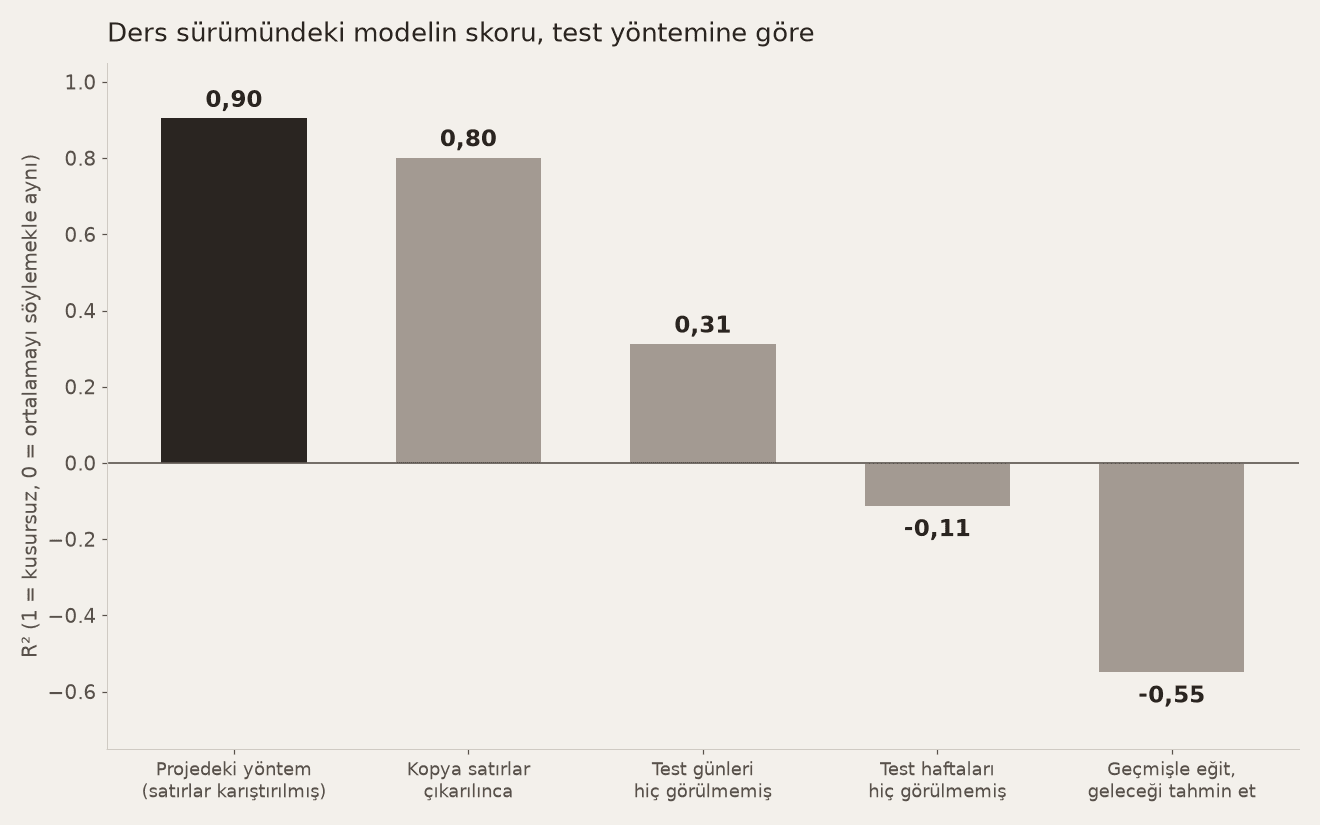
Monitoring stations report pollution only after it happens; an early warning needs a forecast. The second problem was ours: a high test score did not show that the model could actually forecast.
How It Works
A year of hourly PM10, NO2 and SO2 readings from the Ministry of Environment's Bornova Eğitim station, plus temperature, wind, pressure and precipitation from Meteostat.
In the corrected version every hour is one row, weather timestamps are converted from UTC to Turkish time, and hours the station did not measure are left out of the score.
The model looks at the last 24 hours of all three pollutants and the weather at the target hour, and forecasts 1 and 24 hours ahead.
It is trained on December 2024 – October 2025 and tested on October – December 2025, which it has never seen; every score is compared with a "nothing changes" baseline.
Result: R² 0.79–0.85 one hour ahead; 0.20–0.33 a day ahead, with about 20% less error than the baseline.
Architecture & Technical Decisions
Python, pandas, XGBoost and scikit-learn; the course version also had a SHAP explainability analysis and a Streamlit interface.