Sınav Provası
Generates mock exams from a student's own course material, in the style their lecturer asks questions
Screenshots & Schematics
Problem & Challenge
A student revising cannot turn their own slides and PDFs into practice questions, and ready-made question banks know nothing about how their lecturer actually asks. The known problem with having an AI write questions is that the answer key is quietly wrong.
How It Works
The student uploads their course material: text, PDF or slides. Photos and scanned pages are transcribed by a model that can read images (up to 6 images per request).
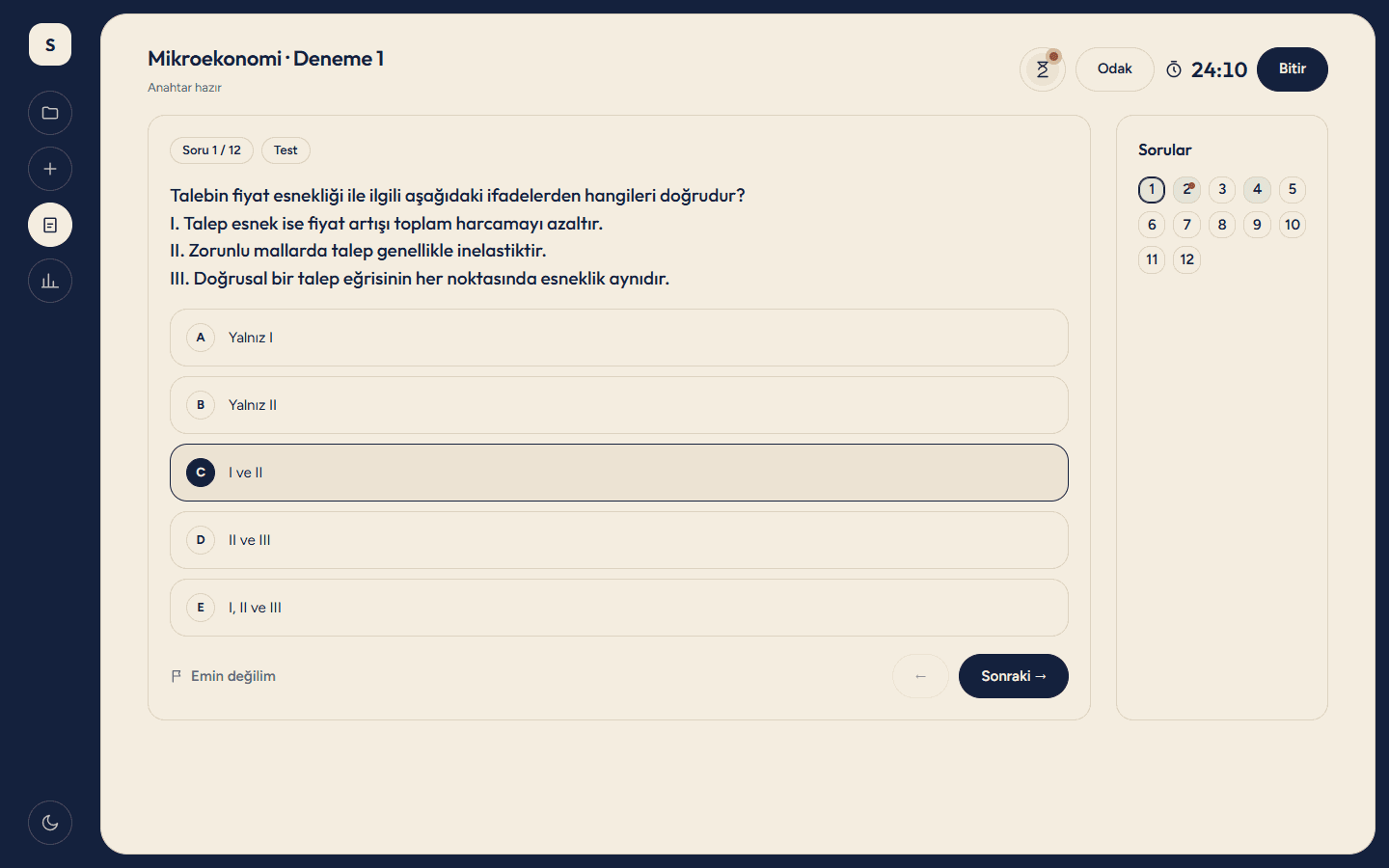
The lecturer's style is picked from ten ready traits: asks with premises (I, II, III), uses "which is not", has you read graphs and tables, gives case scenarios, writes options close to each other, asks from footnotes, asks from outside the material. A free-text note can be added on top.
Questions are written: multiple choice (4 or 5 options), true/false and open-ended; up to 30 questions. Each question must name the file and page it came from ("ders1.pdf - Page 4", "sunum.pptx - Slide 7"), shown per question on the result screen.
A separate, more careful model writes the answer key. It solves everything from scratch and never sees the first model's answers, so it cannot inherit their mistakes. If no option is correct, or more than one is, it flags the question as faulty.
When the material is longer than a service's input limit, each attempt sees a different slice of it, so consecutive attempts spread across the whole material.
The result screen shows weak topics, the questions you were unsure about and a step-by-step solution for each; the exam can also be taken as a PDF.
Architecture & Technical Decisions
A static interface plus Vercel serverless functions (a 300-second ceiling for the long jobs). The AI side sits behind one provider layer: Gemini, Cerebras, Mistral, Groq, OpenRouter and Ollama locally; the order and the model names are set by environment variables. The model that writes the questions and the model that solves the key are deliberately kept apart.